
Teaching Through Objects: Engaging Students with Material Culture in University and Public Settings
On 25 and 26 November 2020, Collaborative Doctoral Students Rosanna Evans, Nicola Froggatt, Mary McMahon and Susan Newell welcomed educators and researchers to an online workshop exploring object-centred teaching and learning practices. This interdisciplinary event was designed to address the gap in guidance and resources that most standard university training programmes offer to early career academic tutors, and to help museum-based professionals when delivering or supporting those who are delivering undergraduate teaching.
Through a blend of presentations, practical sessions and short talks, we explored insights from museum and university practitioners working with diverse collections; experienced different aspects of object-based learning and teaching; and discussed key issues and challenges involved when students learn from historic artefacts.
150 people registered to attend the workshop, with between 60 and 90 people attending individual sessions at any one time. 32 were CDP students. 60 of those registering said they had never taught with objects before; 76 said they had sometimes; and 121 said they frequently used objects in their teaching practice.

Most of the attendees of the live event with experience of teaching with objects had done so in museums or universities
The Programme
Speakers included CDP and other doctoral students, as well as academics and cultural/heritage professionals working in the UK and overseas. Holding this event during the COVID-19 Pandemic came with inevitable challenges, but our online format allowed for the much greater participation of speakers from international universities and institutions. We were delighted to welcome speakers and attendees based across the UK, North America and Europe.
Experienced museum professionals kicked off each day with a session that offered their special insights on the benefits and challenges of teaching with objects: Jim Harris (Andrew W. Mellon Teaching Curator at the Ashmolean) used live-filming to explore a ‘mystery object’ remotely; and Marenka Odlum-Thompson (Research Associate on the Labelling Matters project at the Pitt Rivers Museum) showed us what historic labels can tell us – and what they leave out. The workshop closed with a keynote by Subhadra Das (Curator of Teaching and Research Collections at UCL), who reflected on her life ‘teaching with objects’ and navigating the complex questions that material culture can and should raise.
Workshop papers were divided into four panels, focused on the historic creation and use of ‘teaching collections’; practice, theory, and boundaries; the role of making and tacit knowledge; and issues and challenges involved in designing modules. Speakers covered diverse forms of material culture, from geological specimens to hieroglyph casts to everyday clothing items; and topics ranging from teaching virtual reality technologies to the role of material culture in exploring contested political histories. In a special wellbeing workshop guided by doctoral student Katie O’Donaghue, attendees also reflected on their roles as researchers during the pandemic.
Most sessions were recorded and shared with attendees, as well as an additional 82 people who registered to receive event recordings only. During the event attendees also shared learning and resources on the chat and via a dedicated Padlet page. The event also reached people online through the Twitter hashtag #teachingthroughobjects.
Feedback overview
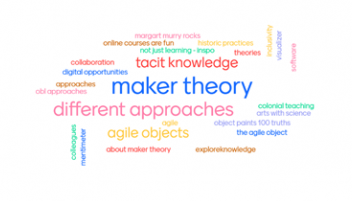
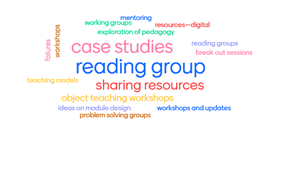
During and following the workshop we used various methods to gather feedback and interact with participants. Menti, a word cloud interactive platform, allowed us to get instant feedback during the event. In response to specific simple questions, participants could give voice to what they had particularly enjoyed or learned from the preceding sessions, and what they wanted to see more of in the future.
- What new things did you learn from yesterday?
- What would you like to see more of in the future?
The Twitter feed was also an important means of gauging reactions which were very positive over the course of the two days:
Today’s #teachingthroughobjects workshop reminding me how much I miss interacting with collections in person 💔 Brilliant session from @AshmoleanMuseum’s Jim Harris to start the day @CDPConnect pic.twitter.com/XjGgkafnTz
— Meg O’Mahony (@meg_omahony83) November 26, 2020
V informative paper by @MarenkaOdlum on the @Pitt_Rivers 'Labelling Matters' project – many similarities w the Petrie. Online reviews describe their old labels (inc racist language) as 'quaint' but this is problematic & incorrectly treats them as objects #TeachingThroughObjects pic.twitter.com/wbalzpwWaG
— Dr Anna Garnett (@Beket_Aten) November 27, 2020
Also, ending with @littlegaudy’s keynote on pathology and science collections was fascinating. It was just so engaging and thought-provoking and it was refreshing to see someone correct their own words as they spoke about human remains & scientific racism #TeachingThroughObjects
— Louise Bell (@LouBell) November 27, 2020
Missing real life #teachingthroughobjects but enjoying papers and images – Jim Harris and agile objects @AshmoleanUEP and @Beket_Aten on Margaret Murray’s incredible teaching collection @PetrieMuseEgypt
— Dr Alexandra Woodall (@alexwoodall) November 26, 2020
Such a thrill to present Margaret Murray's hieroglyphic teaching casts this morning at the #TeachingThroughObjects conference. Lots to think about & so much potential for future research & display at the @PetrieMuseEgypt! #museums #ThursdayThoughts #AmConferencing @UCL_teaching https://t.co/jNJ1po0GE6
— Dr Anna Garnett (@Beket_Aten) November 26, 2020
We used Smart Survey to run a post-event survey (completed by more than 20% of attendees at the live sessions) which allowed for more detailed opinions to be expressed, as well as providing useful positive suggestions for future consideration. Attendees really enjoyed practical sessions and in their feedback reiterated how much they would like more on this in the future . A few constructive comments emphasised the importance of time-keeping and variety of content.
100% of respondents agreed, or strongly agreed, they would feel more confident about using objects in their teaching practice in future and all made thoughtful comments about how they would incorporate lessons from the event into their work. Almost 90% emphasised a desire for more events in the future (either occasional workshops or seminars), and just under 50% were potentially interested in a reading group or a newsletter.
Feedback across the board reinforced a consensus of views expressed by participants in the Chat visible during the actual Zoom sessions: all the workshop sessions were well received, and the organisation that had gone into organising the event was much appreciated.
Conclusion
Teaching Through Objects brought together a broad range of speakers and attendees to discuss a topic about which many feel passionately, but which is not often focused upon as a subject in its own right. Many participants stated that during the pandemic, when so many are more distanced from the people and objects that they normally work with, that this event offered a particularly valuable opportunity to meet and engage with a wider community of researchers and heritage/museum professionals. We hope that the contacts and learning generated over these two days will develop into other activities that continue the conversation in new and exciting ways.
The Teaching Through Objects team are grateful to the AHRC Student-Led Activity Fund for supporting our event. This funding allowed us to involve some of our excellent speakers, and provide live captioning throughout the event via Stagetext, which was explicitly appreciated by participants. We also particularly want to thank Sarah McEvoy for all her assistance behind the scenes.